
She Thought She Had Completed Her Training Hours—Until Her School Checked the Certificate


By the time Meera uploaded her last training certificate, it was nearly eleven at night.
Her lesson plans were ready. A stack of notebooks waited on the dining table. On her laptop, a folder labelled “Annual Professional Development” finally appeared complete.
She added the hours once more.
Forty hours already recorded through school-arranged programmes and other accepted professional development activities. Another ten hours from an online training package she had recently completed.
Fifty hours.
Meera closed her laptop with relief.
She had taught primary classes for eight years. Like many educators, she fitted professional learning around teaching, assessments, parent meetings and responsibilities at home. Completing her school’s annual training requirement had taken planning.
She believed she had done everything required.
Three days later, the school’s training coordinator called.
“Meera, we need some additional information about your last certificate. We haven’t been able to verify it.”
She opened the folder again.
Her name was there. The programme title was there. So were the words “10 Hours of Professional Development”.
She could not understand what was missing.
“I paid for the programme,” she said. “I attended the sessions. I have the certificate.”
The coordinator replied gently: “We need the provider to confirm that this certificate was issued to you and that you completed the hours it records.”
That was when Meera realised she had never asked how the certificate could be checked.
Several weeks earlier, a colleague had forwarded an advertisement to a teachers’ messaging group. It offered a ten-hour online programme covering classroom management, assessment and teaching strategies.
The fee was ₹99. The sessions fitted around her school timetable. A certificate was included.
For Meera, the combination seemed practical. The topics were relevant, and she could afford the fee.
She registered, saved her payment confirmation and attended five two-hour sessions. She took notes and identified a few ideas she wanted to try with her pupils.
At the end of the programme, the organiser shared a certificate template and instructed participants to enter their names before downloading it.
Meera hesitated briefly. She had expected a certificate issued individually to her.
But the organiser reassured the group that the document was sufficient. Other participants were thanking the trainer. She assumed this was simply how the provider handled certificates.
She entered her name and saved the file.
The document looked complete. The record behind it was missing.
During the school’s annual review, the coordinator could find no unique certificate reference, individual completion record or verification link. The document carried a provider’s brand name and an image of a signature, but neither established that Meera’s participation had been checked.
The school looked for an online verification facility. There was none.
That alone did not end the review. The coordinator contacted the organiser and requested confirmation through its official communication channel.
The request was straightforward: confirm Meera’s identity, the programme she had completed, the session dates and the number of eligible hours being certified.
The school also asked for an attendance or completion record that could support the certificate.
The provider replied that participants should submit the certificate already supplied. It did not provide an individual record or confirmation of Meera’s completion.
A second request produced no further evidence.
Meanwhile, Meera searched through her messages. She found the payment receipt, joining links, session reminders and her notes.
She sent everything to the coordinator.
These materials helped explain what she had registered for and supported her account of attending. Under this fictional school’s verification procedure, however, they did not establish the full ten hours claimed on the certificate. The school needed reliable confirmation of completion, and the provider had not supplied it.
Meera felt increasingly uncomfortable.
She had acted in good faith. Now she worried that the missing documentation made her look careless—or worse, dishonest.
When she met the principal, she brought her notebook.
“I really did attend,” she said. “These are the notes I made.”
The principal read them.
“We can see that you engaged with the programme,” she said. “We’re asking the provider to support the training record it gave you. You should not have to reconstruct that record on your own.”
The principal explained that the school was responsible for maintaining training records it could substantiate. It could not approve an unsupported entry simply because a fee had been paid or a document displayed the required number of hours.
The ten hours remained pending while the school gave Meera time to seek further evidence.
The provider still did not supply it.
When the school reached its reporting deadline, it declined to credit those ten hours.
Meera’s training record at the review deadline
Previously accepted professional development: 40 hours
Additional hours claimed through the disputed certificate: 10 hours
Additional hours accepted after verification attempts: 0 hours
Total accepted hours: 40 hours
Shortfall against the school’s annual requirement: 10 hours
Meera had expected her record to show completion. It showed a shortfall.
The school arranged a corrective learning plan with her. Any further training would be recorded on its actual completion dates and considered under the applicable rules. It could not simply rewrite the earlier record as complete.
The consequence was frustratingly practical: more scheduling, more documentation and additional learning commitments during an already busy period.
The ₹99 mattered. So did the evenings she had set aside.
What upset her most was the assumption she had made: that receiving a certificate meant the provider would be able to stand behind it.
A teacher should be able to ask an issuer to substantiate the certificate it provides.
Meera’s fictional experience illustrates why training documentation deserves attention before enrolment.
NCERT’s guidelines for 50 hours of continuous professional development describe maintaining a portfolio with certificates or other evidence supporting completed activities, followed by assessment by the relevant authority. They place documentation within a wider process of professional learning and review. Read NCERT’s CPD guidelines.
Acceptance also depends on the applicable training framework. For example, CBSE’s April 2025 guidelines distinguish between Board-arranged and school-arranged components and specify requirements for activities and records. A collection of certificates totalling 50 hours does not automatically satisfy every requirement. Read CBSE’s 2025 CPD guidelines.
Three separate questions therefore matter:
Authenticity: Did the named provider actually issue this certificate to this educator?
Completion: What reliable evidence supports the attendance, assessment or learning hours recorded?
Eligibility: Can this programme count towards the particular requirement the educator needs to fulfil?
A certificate may be authentic while the programme is ineligible for a particular category. A relevant programme may still leave a teacher with inadequate evidence of completion.
Both checks deserve attention.
An online verification service can make authenticity checks easier. A unique certificate number or QR code should lead to a record that matches the educator, programme and relevant completion details.
The presence of a QR code alone proves little. A code that opens a homepage or advertisement does not verify an individual training record.
Equally, a paper certificate is not automatically invalid, and the absence of a public online directory does not automatically make a certificate unacceptable. An identifiable institution may verify it through official records or direct confirmation. In Meera’s story, the decisive problem was that the provider failed to supply reliable confirmation through any route.
Before paying for training, teachers can protect their time and effort by taking a few practical steps:
Confirm the programme’s acceptability with the school. Check the topic, provider, format and category of hours before relying on it for a requirement.
Ask to see a sample certificate. Check that it clearly identifies the issuer, programme, participant, dates and hours or completion details.
Ask for a demonstration of verification. Establish what the school will be able to check and whom it can contact.
Understand the completion requirements. Find out whether certification depends on attendance, recorded-content completion, assessment or another stated criterion.
Keep supporting records. Save registration details, payment receipts, correspondence, assignments and completion confirmations.
Check the certificate promptly. Resolve missing information while the programme and provider are still readily accessible.
Submit records throughout the year. Early review gives teachers and schools time to address problems before a reporting deadline.
Schools can help by explaining their requirements clearly and reviewing unfamiliar programmes before staff enrol. Teachers should have access to guidance while making the decision, rather than discovering a documentation problem months afterwards.
At The Pedagogy Community, we take professional learning and training documentation seriously. Our certificates include QR codes and serial numbers for verification, giving educators and schools a way to check the records we issue. Teachers should also confirm that their chosen programme fits their school’s applicable training requirements. Learn about our training and certification process.
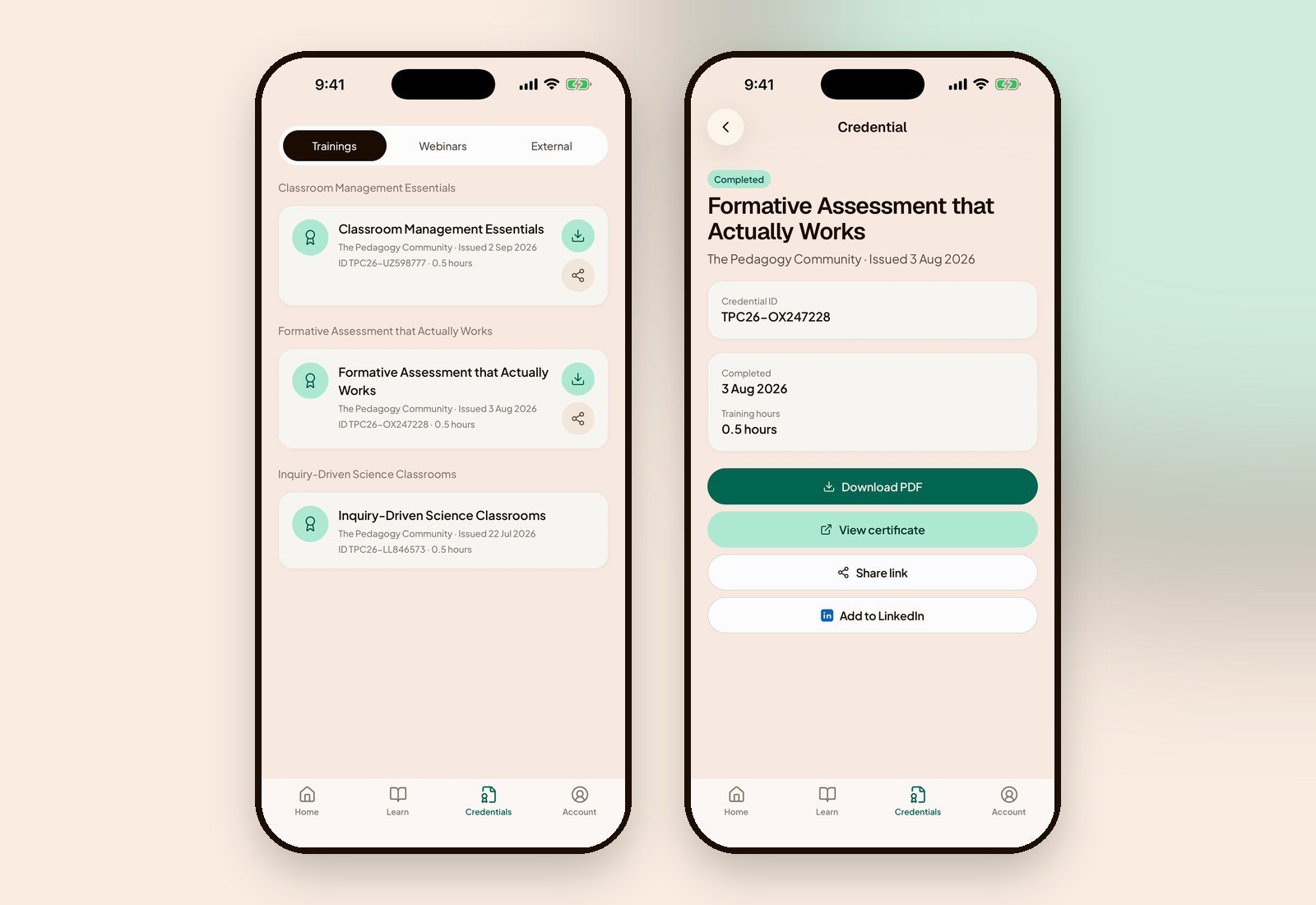
Meera’s experience is fictional. The question it raises is one every educator can ask before enrolling:
“If my school needs to verify this certificate, exactly how will you help them do it?”
A responsible training provider should have a clear answer.
Before you accept a certificate as evidence of your professional development, make sure the issuer can stand behind it. Your time, money and professional record deserve that assurance.
More from the blog
Why Quality Teacher Training Matters—and Why the Platform You Choose Matters Just as Much
When teachers enrol in a training programme, they invest more than a registration fee. They invest their time, attention and trust. They expect to leave with knowledge, strategies and confidence they can bring into their classrooms. That expectation deserves to be taken seriously. For preschool educators, school teachers and school leaders across India, continuing professional development is an im

Your School Needs a Teacher Training Platform That Works for Teachers—and for You
At the end of an academic year, a school should be able to answer a straightforward question: which teachers have completed their required professional development, and what evidence supports that record? Answering it can become surprisingly difficult when information is scattered across printed certificates, email attachments, messaging groups and individual spreadsheets. One teacher has submitte

Bulk Registration Is Now Open to Teacher Groups Across Schools
Learning with colleagues should be easy to organise—even when you work at different schools. At The Pedagogy Community, we have updated our bulk registration process to make that possible. Teachers can now organise a group registration for their friends and colleagues across schools and access the available bulk-registration discount. The change starts with a simple requirement: each participant n

Responses (0)
Loading responses…