
A Free Resource Library for Teachers, Supported by Our Community

A useful teaching resource can help you prepare a lesson, understand a topic better or try a different approach in your classroom.
Finding that resource, however, can take time. Teachers may have to search several websites, follow links shared in different groups and sort through material before finding something relevant.
At The Pedagogy Community, we want to make that process easier.
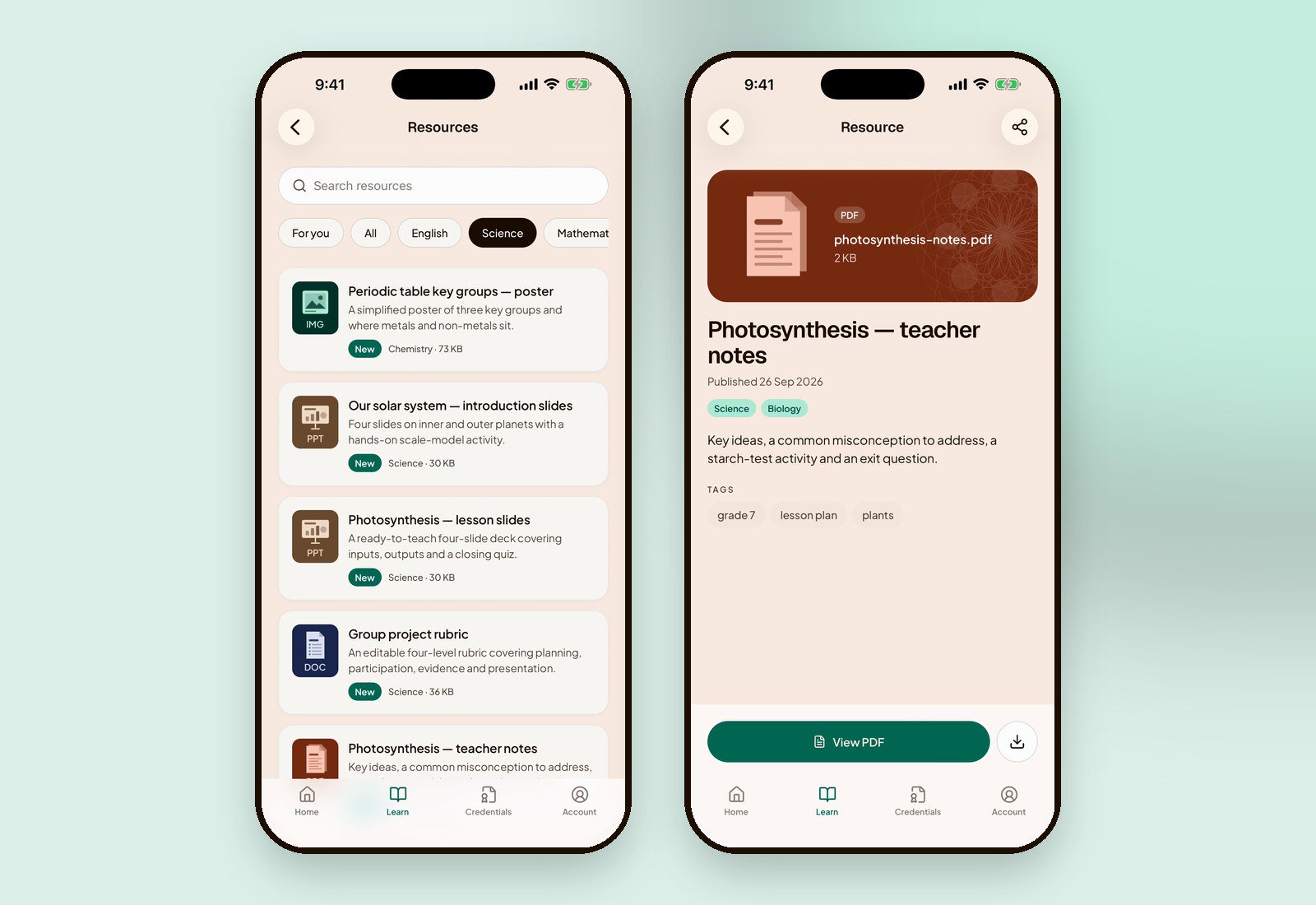
Our free resource library brings teaching and learning materials together in one place. Educators can access it through the Learn section of the myTPC app after completing onboarding.
You do not need to purchase a webinar to access these free resources. The library is available to educators around the world who join the platform and complete their profiles.
There is no fee to access or download the resources in our free library.
We want teachers to be able to find useful material, learn from it and bring fresh ideas into their classrooms.
But how can a platform provide resources for free when creating and maintaining them costs money?
The answer is community support.
Income from our paid webinar registrations helps us create resources and maintain the library. When educators pay to attend our webinars, those fees help support the wider work of the platform, including resources that other teachers can access without paying.
This allows the benefits to reach beyond the participants in a particular training session.
A teacher who registers for a webinar supports their own professional learning. That participation also helps us keep useful resources available to the wider teaching community.
The resources are free for teachers to access. The work behind them still has a cost.
Creating material takes time. Organising contributions, keeping the library accessible and maintaining the app also require ongoing work.
We cover those costs through the wider operation of The Pedagogy Community, rather than adding an access fee to these free resources.
This is an important part of what we want to build: a platform where paid professional learning also helps support wider access to educational material.
Our library grows through more than one source.
Some resources are created by The Pedagogy Community. Others are submitted by teachers and members of our community who want fellow educators to benefit from useful material.
Some contributed resources are also freely available on other websites. Bringing them together helps teachers discover material without having to search across several different places.
Under each resource, you can see who provided it. This helps you understand where the contribution came from and gives credit to the people supporting the library.
For resources from outside The Pedagogy Community, ownership remains with the original creator or the relevant rights holder. The person submitting a resource may be its creator or may be sharing material from another source. Making it available in our library does not transfer ownership to The Pedagogy Community.
Please check the source and any usage terms attached to a resource before sharing or changing it. Free access does not always mean that every kind of reuse is allowed. Keeping the original credit with the material is also important.
Our aim is to make useful resources easier to find while respecting the people who created them.
The community’s role matters because teachers learn a great deal from one another.
An educator may discover a helpful resource while preparing for a lesson. Another may create material to explain a difficult concept. When suitable resources are shared, more teachers have the chance to learn from that work.
The teacher who benefits may work in a different school, teach in another city or live in another country.
That is why we have made access to the free library available across our community, rather than limiting it to teachers who have paid for a particular programme.
Getting started is simple:
Download the myTPC app.
Complete the onboarding process. Add the basic information requested to set up your profile.
Open the Learn section.
Browse the available resources. You can choose material that interests you or select resources related to the subject you added during onboarding.
Download the resources you need. Use them for your learning and teaching, and share them in line with their stated usage terms.
Completing onboarding helps us understand your teaching interests and makes it easier for you to find relevant material.
You can explore resources for your own subject or look beyond it when you want to learn something new.
Of course, finding a resource is only the first step. Its value comes from how you use it.
Read through the material before taking it into your classroom. Consider whether it suits your students’ age, learning needs and level of understanding. Where changes are permitted, adapt it to your teaching context.
A resource that works well in one classroom may need a different explanation or activity in another. Your judgement as a teacher remains important.
Our aim is to keep growing a library that can bring together hundreds, and eventually thousands, of useful resources. As it grows, we want it to remain easy to access and helpful to the educators who use it.
We do not charge an access or download fee for the resources in this free library.
To the teachers who contribute material, thank you for helping other educators. To the participants who register for our paid webinars, thank you for supporting the work that helps us maintain these free resources.
Both forms of support help the community grow.
Complete your onboarding on the myTPC app, open the Learn section and explore the free resource library.
Find something useful, take time to learn from it and bring what works into your classroom.
More from the blog
Why Quality Teacher Training Matters—and Why the Platform You Choose Matters Just as Much
When teachers enrol in a training programme, they invest more than a registration fee. They invest their time, attention and trust. They expect to leave with knowledge, strategies and confidence they can bring into their classrooms. That expectation deserves to be taken seriously. For preschool educators, school teachers and school leaders across India, continuing professional development is an im
She Thought She Had Completed Her Training Hours—Until Her School Checked the Certificate
By the time Meera uploaded her last training certificate, it was nearly eleven at night. Her lesson plans were ready. A stack of notebooks waited on the dining table. On her laptop, a folder labelled “Annual Professional Development” finally appeared complete. She added the hours once more. Forty hours already recorded through school-arranged programmes and other accepted professional development
Your School Needs a Teacher Training Platform That Works for Teachers—and for You
At the end of an academic year, a school should be able to answer a straightforward question: which teachers have completed their required professional development, and what evidence supports that record? Answering it can become surprisingly difficult when information is scattered across printed certificates, email attachments, messaging groups and individual spreadsheets. One teacher has submitte
Responses (0)
Loading responses…